Best Duos & Comms for Skirmish 2v2 Mode
Quick Navigation
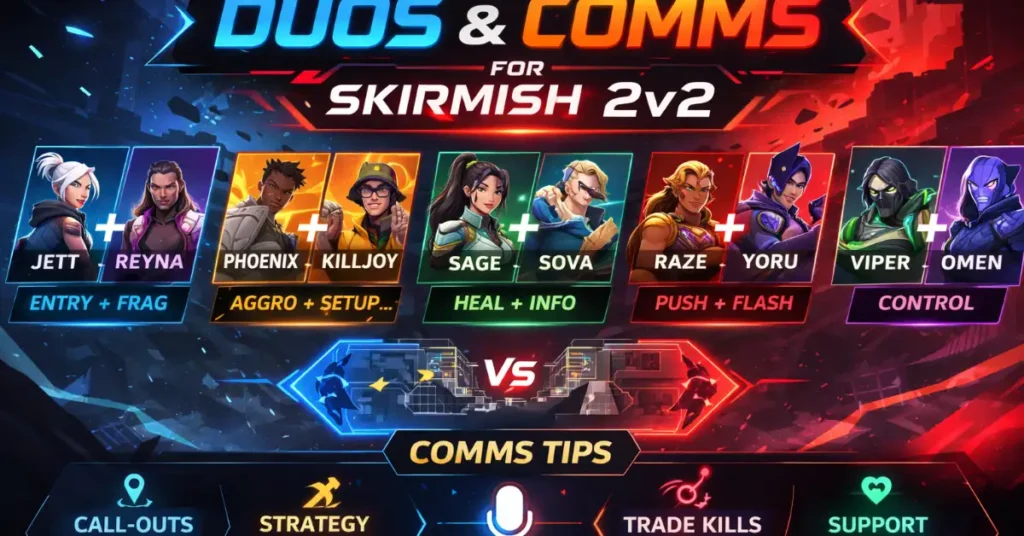
Why Duos and Comms Matter So Much in 2v2
In normal ranked games, you can sometimes win rounds because three teammates popped off while you stayed quiet. In Skirmish 2v2, there is nowhere to hide – it is literally just you and one other person versus two enemies, every single round.
That means spacing, trades, and clear callouts are worth more value here than in any other mode. If you and your duo learn how to swing together, isolate 2v1s, and keep each other informed, you will win far more fights than “better aim but no comms” duos.
Best Duo Roles for Skirmish 2v2
Even though agents and abilities do not matter in Skirmish 2v2, you can still think in terms of “roles” to make your communication cleaner. You do not need fancy comps – just agree on who is doing what each round.
1. Entry + Trade Duo
This is the simplest and strongest structure for most players. One person takes responsibility for taking the first contact, while the other focuses on trading and cleaning up.
- Entry: Takes the first peek, clears common angles, and calls out enemy positions quickly.
- Trader: Holds slightly behind, ready to swing the moment the entry takes a fight, ensuring you never lose a 1v1 without an instant trade.
2. Lurk + Anchor Duo
On some Skirmish layouts, you can play a bit slower. One player holds a strong angle and refuses to give space, while the other tries to find flanks or off‑angles.
- Anchor: Stays in a reliable position, communicates when enemies are approaching, and avoids ego‑swinging.
- Lurker: Explores off‑angles, listens for info, and pinches enemies when the anchor is ready to fight.
3. “Star” + Support Duo
If one of you is clearly the stronger aimer, you can lean into it. Let that player take most of the early duels while the other sets up trades, crossfires, and safe positions.
- Star: Takes initiative, chooses where to fight first, and calls the pace of the round.
- Support: Focuses on surviving, playing off the star’s positioning, and finishing low‑HP enemies.
Essential Comms for Winning 2v2 Fights
You do not need full pro‑level IGLing to win in Skirmish 2v2. A small set of simple callouts, used consistently, will already put you ahead of most random duos. Here are the most important ones:
- “Swing together in 3, 2, 1…” – Countdowns force you to peek at the same time instead of staggered, which makes trading way easier.
- “I’m baiting, you trade.” – Tells your duo you are going to take a risky peek just to get info or damage, and they should be ready to punish instantly.
- “One close left, one back site.” – Quick, clear info about positions. Avoid “over there” or “he’s somewhere behind”, be specific.
- “Play my contact.” – If you are holding an angle, this tells your duo not to peek until an enemy swings into your crosshair, then they swing off your shots.
- “Reset, don’t ego swing.” – Reminds both of you to stop wide‑swinging when you have the HP or numbers advantage. Play together and force the enemy to overpeek.
Make these phrases normal between you and your duo. After a few sessions, you will start saying them automatically, and your 2v2 rounds will feel much more controlled.
Simple Duo Routines to Practice
To really level up your Skirmish 2v2 chemistry, treat a few rounds in every session as “practice reps” instead of pure win‑at‑all‑costs. Here are some routines you can try:
Drill 1 – Double Peek Every Fight
For one full Skirmish match, make a rule: you are not allowed to peek alone unless one of you is already dead. Count down every swing – “3, 2, 1” – and commit together. You will immediately feel how many fights you win simply by not fighting solo.
Drill 2 – One Baits, One Trades
Play a few rounds where one of you is permanently the bait. That player takes all the risky swings, jump‑spots, or shoulder peeks, while the other holds a strong off‑angle and only reacts when the bait is shot at. This teaches you to trade instantly instead of waiting.
Drill 3 – Calm Clutch Voices
In 1v2 or 2v1 situations, pick one person to be the “calm voice” and let them make the final calls. Instead of both players panicking and talking over each other, this practice keeps your comms clean and your clutch decisions clearer.
Guides & Tools to Combine With This
Strong duos and clean comms are only half of the recipe. The other half is having aim and settings that you actually trust when it is time to swing. Here are the best BattlePooja resources to stack with your Skirmish sessions:
- PSA Method Calculator: Make sure you and your duo are not fighting your mouse. Use our free PSA Method Calculator for Valorant to find a sensitivity range that suits each of you before you grind Skirmish.
- Pro‑inspired settings & crosshairs: If you want an example of how high‑sens aim can work in pure gunplay, read our TLN Primmie pieces – Primmie Valorant Settings 2026 and Can You Climb Ranked With Primmie’s High Sensitivity? – then test similar setups together in Skirmish.
If you just want to look extra clean while you roll other duos, you can also check which rifle and knife skins are worth buying during Night Market in our guide: Best Skins to Grab in the February 2026 Valorant Night Market.
FAQ – Skirmish 2v2 Duos & Comms
Do duo roles really matter if there are no abilities?
Yes. Even without abilities, deciding who takes first contact and who plays for trades makes your rounds much more structured. It stops you from both swinging randomly and dying alone.
What if my duo never talks?
Start with very simple comms that are easy to say, like “swing with me”, “I bait, you trade”, or “play my contact”. Once your friend sees that these calls win rounds, they will usually talk more.
Can I practice these comms with randoms?
You can, but it is less reliable. Skirmish 2v2 is at its best when you have one regular partner you can build habits with over time, similar to practicing set plays in any team sport.
Will this actually help my full 5v5 ranked matches?
Yes. Good spacing, trading, and calm clutch comms all transfer directly to 5v5. If you can do these basics perfectly in 2v2, you will feel a big difference when you go back to full teams.

Hi, I’m Pooja—Gamer, Creator, and Performance Tool Builder. After grinding in Valorant, I realized competitive players needed clean, data-driven calculators without the heavy ads. I created BattlePooja to bridge the gap between technical hardware optimization and in-game mechanical skill.