Masters Santiago 2026: Format, Teams, Schedule and How It Works (Simple Explainer)
Masters Santiago 2026 is the first global Valorant Champions Tour event of the year, bringing 12 of the best teams in the world to Chile. This simple explainer breaks down the format, all teams, the schedule and how the Swiss + double‑elimination system actually works, without esports jargon. If you want to copy pro comps for ranked, pair this with our Valorant Best Agents 2026 Tier List.
Quick overview: What is Masters Santiago 2026?
Masters Santiago 2026 is the first international LAN of the Valorant Champions Tour season. It features 12 teams from the four main VCT regions (Americas, EMEA, Pacific and China) fighting for prize money and Championship Points toward Valorant Champions later in the year.
The event takes place at Espacio Riesco in Santiago, Chile, from February 28 to March 15, 2026. It uses a two‑part structure: a Swiss Stage for some teams, followed by a double‑elimination playoff bracket for the top eight.
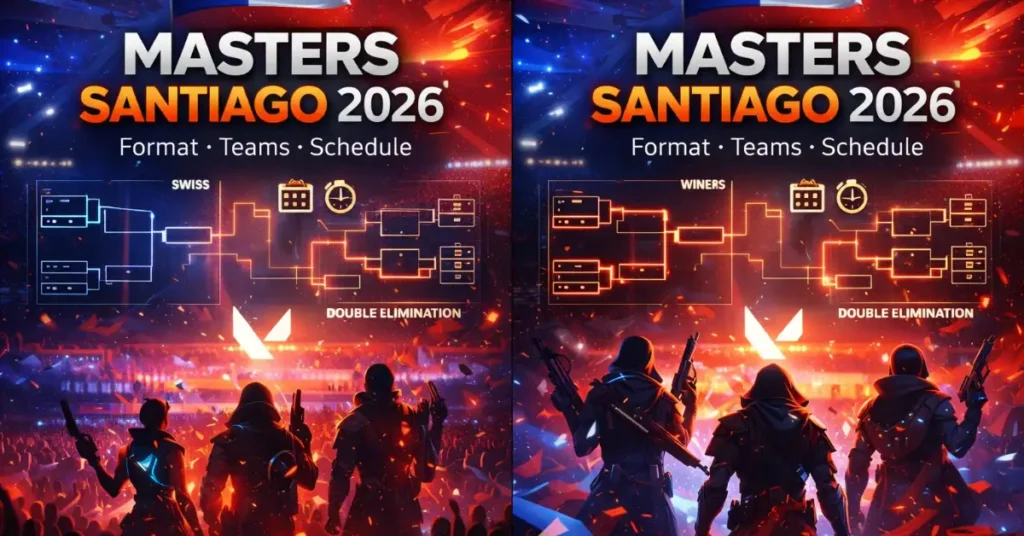
Format explained: Swiss Stage + Playoffs
Two stages only
The whole tournament is split into:
- Swiss Stage – where 8 teams fight to qualify or get eliminated.
- Playoffs – where the final 8 teams battle in a double‑elimination bracket.
Swiss Stage (Feb 28 – Mar 4)
The Swiss Stage is like a short league where you just need 2 wins to go through or 2 losses to go home. Only 8 of the 12 teams play this part – the ones that finished 2nd and 3rd in their regional Kickoff tournaments.
- 8 teams start in the Swiss Stage.
- Every match is best‑of‑three (Bo3).
- If a team reaches 2 wins, they qualify for Playoffs.
- If a team reaches 2 losses, they are eliminated from the event.
Teams are paired each round against opponents with similar records (1‑0 vs 1‑0, 0‑1 vs 0‑1 etc.), which keeps most matches competitive even early on.
Playoffs (Mar 6 – Mar 15)
Once Swiss is over, 8 teams remain for the Playoffs:
- 4 teams that qualified from Swiss.
- 4 Kickoff champions (one from each region) that skipped straight to Playoffs as top seeds.
The Playoffs use a double‑elimination bracket:
- Everyone starts in the upper bracket.
- If you lose once, you drop to the lower bracket.
- If you lose again in lower bracket, you’re out.
- The last team in the lower bracket plays the upper‑bracket winner in the grand final.
- Most matches are Bo3, with the lower‑bracket final and grand final as Bo5.
This format means one bad day doesn’t instantly kill a top team’s run, but you still need to be consistent to win it all.
All 12 teams and regions
There are 12 teams in total at Masters Santiago 2026 – three each from VCT Americas, VCT EMEA, VCT Pacific and VCT China. Each region sent its Kickoff champion plus two more top performers.
| Region | Teams | Notes |
|---|---|---|
| VCT Americas | FURIA, G2 Esports, NRG | FURIA are the Kickoff champions and start in the Playoffs as a top seed. |
| VCT EMEA | BBL Esports, Gentle Mates, Team Liquid | BBL won EMEA Kickoff and are a first seed; Liquid returns with a slightly rebuilt roster. |
| VCT Pacific | Nongshim RedForce, T1, Paper Rex | NS RedForce are the Pacific champions; PRX and T1 bring back familiar star cores. |
| VCT China | All Gamers, XLG Esports, EDward Gaming | All Gamers enter as China’s first seed, with EDG aiming to repeat their previous international form. |
Schedule and important dates
Masters Santiago runs for just over two weeks, with a short break between Swiss and Playoffs.
- Overall event: February 28 – March 15, 2026.
- Swiss Stage: February 28 – around March 4.
- Break / dark day: usually one off‑day between stages.
- Playoffs: March 6 – March 15 (including grand final).
Exact daily match times can shift based on broadcast slots and local time zones. For the most accurate live schedule, use:
- The official Valorant Esports schedule (auto‑converts to your time zone).
- The Liquipedia page for Masters Santiago 2026, which shows brackets and match days.
How to watch Masters Santiago (and from India)
All Masters Santiago 2026 matches are streamed for free on the official Valorant Esports channels:
If you’re watching from India, most matches will air in the late evening or night because Santiago is several hours behind IST. The official schedule page will automatically show times in IST if your browser is set to India time.
If you want to turn what you watch into ranked gains, combine this event with our tools: Valorant Sensitivity Finder & Converter 2026 and Valorant Aim Setup Wizard so your crosshair and sensitivity match how pros aim.
FAQ: Simple answers about Masters Santiago 2026
How many teams play at Masters Santiago 2026?
There are 12 teams total, with 3 from each of the four main Valorant regions: Americas, EMEA, Pacific and China. Four of them (the Kickoff champions) start directly in the Playoffs, while the other eight have to fight through the Swiss Stage.
What does “Swiss Stage” mean in Valorant?
A Swiss Stage is a mini‑league where teams play opponents with similar records. At Masters Santiago, teams in Swiss qualify to Playoffs after 2 wins or are eliminated after 2 losses. All Swiss matches are best‑of‑three, which keeps things competitive but fast.
Where can I see the full match schedule?
The easiest place is the official Valorant Esports schedule at valorantesports.com/schedule, which shows every match in your local time zone. You can also use Liquipedia’s Masters Santiago 2026 page to view the bracket, match days and results in one place. Once you know which teams and agents are popping off, you can swap your ranked mains using our 2026 agent tier list.
Do I need to watch the whole event to enjoy it?
Not at all. If you’re new to Valorant esports, you can start with Playoffs when only the top eight teams remain. For maximum storylines and chaos, you can tune into the Swiss Stage too, but the upper and lower‑bracket playoff matches are where the biggest hype and elimination games happen.

Hi, I’m Pooja—Gamer, Creator, and Performance Tool Builder. After grinding in Valorant, I realized competitive players needed clean, data-driven calculators without the heavy ads. I created BattlePooja to bridge the gap between technical hardware optimization and in-game mechanical skill.